Human capital & EU
Productivity, labour participation, pensions, convergence.
2035 — Raise HALE towards the EU average
Albania Healthy Longevity 2035
Turning ageing from a demographic challenge into a source of competitiveness, investment and international positioning in the Western Balkans.

Median age, January 2026 — matching the EU average of 44.9.
The turning point
Median age rose from 34.2 years in 2014 to 45.0 in 2026, against 44.9 across the EU-27. Over the same decade the EU aged by 2.4 years — Albania by 10.8.
2.34 M
Total population
Down from 2.83 million in 2011
~20%
Population aged 65+
Up from 11.3% in 2011
35.7%
Old-age dependency
Up from 16.4% in 2011
1.18
Workers per person 65+
Down from 8.1 in 2002
Source: INSTAT, Population of Albania, 1 January 2026
Vision 2035
The outdated view
Ageing as an inevitable fiscal crisis
A burden on national pension systems
A strictly healthcare and Ministry of Health problem
The 2035 vision
Albania as a nation of healthy longevity
Ageing as a driver of national competitiveness
A strategic asset for EU integration and investment
Roadmap 2035
Productivity, labour participation, pensions, convergence.
2035 — Raise HALE towards the EU average
Home, community, residential and geriatric care.
2035 — A certified network in every municipality
Preventive medicine, biomarkers, AI and care technology.
2035 — A functioning AgeTech ecosystem
Wellness provision and the authentic Blue Zones.
2035 — The wellness destination of the region
Return of expertise, remote work, partnerships.
2035 — An active diaspora network
Each pillar carries a 2035 objective measured against a verified 2026 baseline.
The demographic mechanism
Three forces act at once: fertility below replacement since 2001, rising life expectancy, and emigration concentrated among those aged 15 to 29. The pyramid narrows at the base and widens at the top simultaneously — a harder problem than ageing driven by longevity alone.
Population by age band, indexed. Source: INSTAT, 2011 Census and 1 January 2026 release.
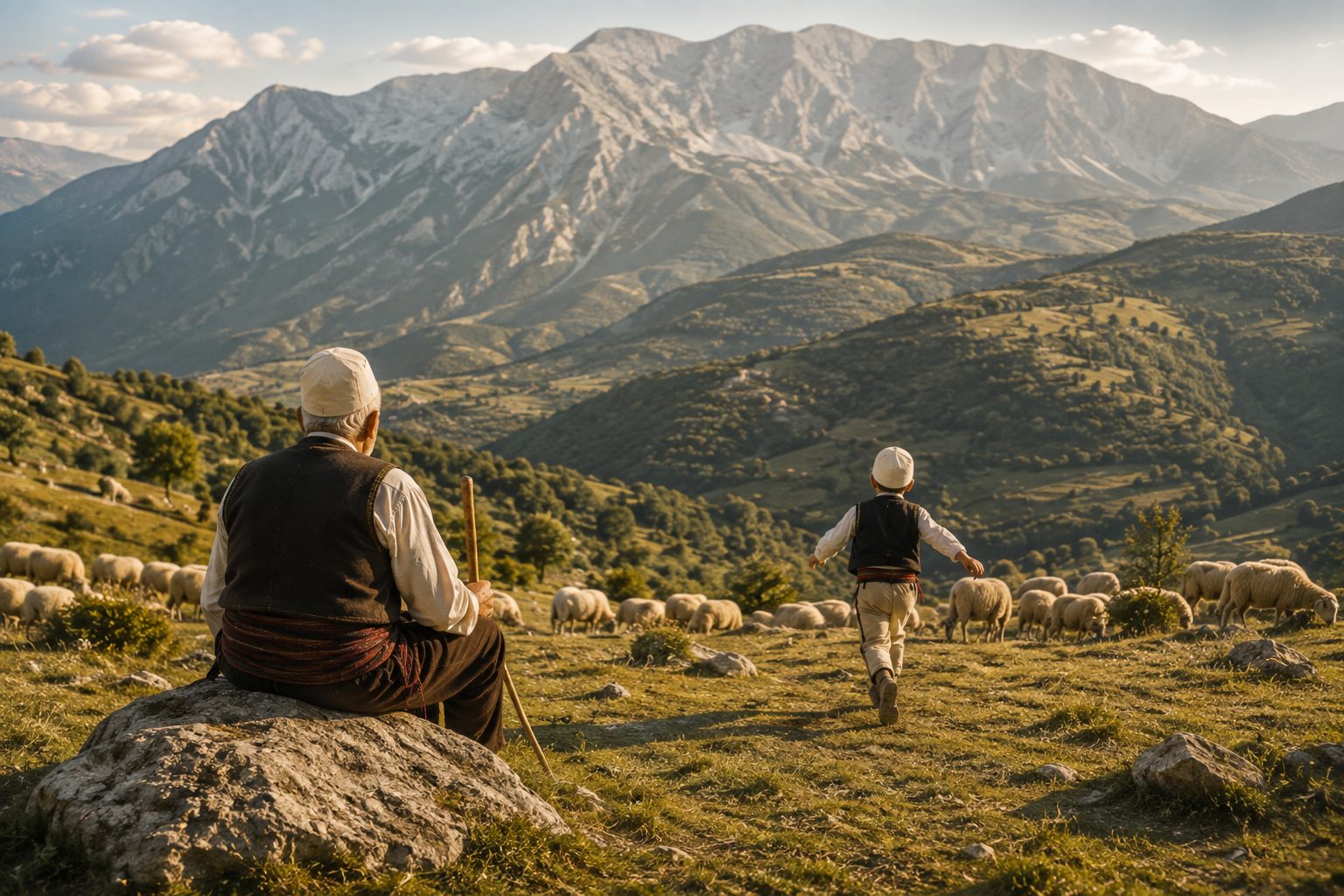
“Mënyra se si plakemi është historia që ju lëmë brezave.”
The central problem
Life expectancy has risen, but healthy life expectancy remains around 66.7 years — leaving 10 to 13 years lived with chronic disease or limitation. This gap is where healthy-longevity interventions yield the highest return.
Source: WHO, IHME, INSTAT.
Where this is delivered
Ageing in Albania is deeply unequal across the territory. In at least 42 municipalities the old-age dependency ratio exceeds 30%. In several coastal and mountain municipalities people aged 65 and over make up more than half the population.
46.1%
Gjirokastër
highest dependency
19.9%
Kukës
lowest dependency
+0.7%
Tirana
the only municipality growing
The care system today
Building care capacity is not only a social obligation. It is sector creation — jobs, a certified private market, care technology and a destination for strategic investment.
6
public residential homes nationwide
Maximum capacity approximately 332 places.
2
public multipurpose day centres
Kamëz and Saranda. Capacity approximately 85 places.
~64,000
people over 60 live alone
Social isolation is a direct health-risk factor.
0.01%
of GDP spent on public care
Approximately 0.03% of public expenditure.
No legal framework for long-term care
No dedicated social-protection branch and no legal definition. Planning is impossible without it.
Source: State Social Service; Supreme State Audit (KLSH), 2023 audit.
Every additional year lived in good health is preserved human capital.
Our work
A research and policy hub coordinating the initiatives and anchoring the Roadmap in an institution.
Home and community care, a long-term care legal framework, geriatric units and provider certification.
An annual comparison of municipalities on healthy-longevity and age-friendliness indicators.
Pilot municipalities under the WHO framework, each with a local champion and low-cost interventions.
The region's wellness destination, linked to the Strategic Investment mechanism.
Helping employers reduce chronic disease and raise productivity.
Start-ups in digital health, health AI and care technology.
The evidence
Healthy life expectancy (HALE)
~66.7 years
+3 years toward ~70
WHO / IHME
Life expectancy–HALE gap
~10–13 years
≤ 8 years
WHO / INSTAT
Home-care coverage, 65+ in need
< 2%
25%
State Social Service
Municipalities with an age-friendly plan
0
30+
Municipalities network
Certified private providers
a small minority
100% of the market
Certification register
Labour-force participation, 55–64
to be measured
+10 points
INSTAT (LFS)
2026 baseline → 2035 target. Full framework, methodology and sources are published in the Roadmap.
Get involved
In at least 42 municipalities the dependency ratio exceeds 30%. The WHO age-friendly framework begins with a local champion, not a large budget.
Join the networkAn employee in good health is more productive. Workplace programmes are one of the seven flagship initiatives.
Register your interestThe Roadmap connects to EU instruments — Silver Economy, EIP on AHA, SHARE — and to the national Strategic Investment mechanism.
Explore partnershipNet migration of −28,531 in 2025 is the largest demographic weakness. The Roadmap reframes the diaspora as a network of expertise.
Join the networkCorporate advisory and workshop formats are in development and open in 2027. Registering interest places no obligation.
2026 to 2035
The Roadmap is sequenced. Foundation establishes the institution and the framework; build-out scales delivery; consolidation measures the return.
01
2026–2027
We are here
02
2028–2031
03
2032–2035
municipalities. One national system.
Delivered locally · Measured nationally
Strategic partners